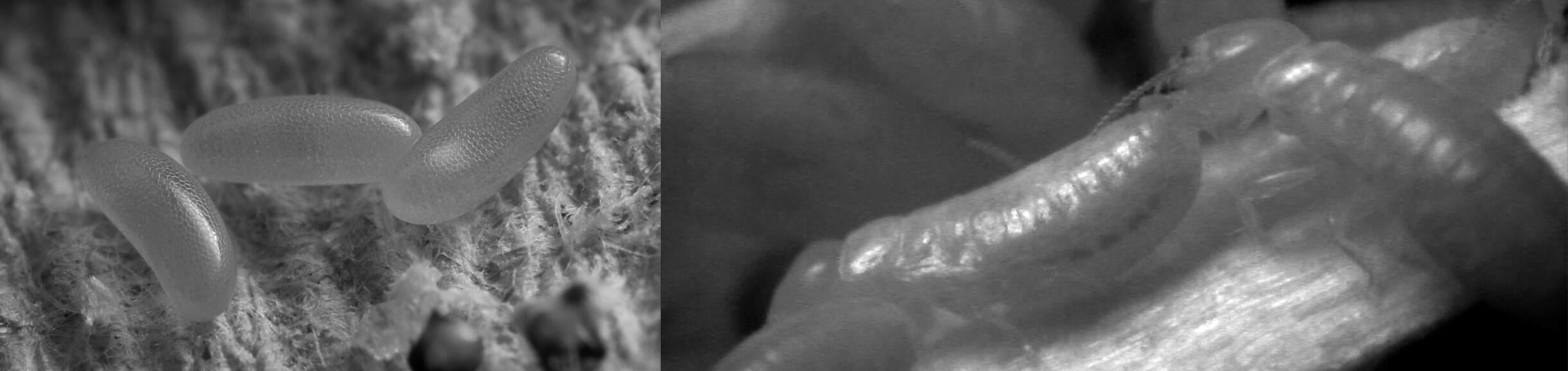
Due to their cryptic lifestyle and relatively slow developmental cycle, many aspects of drywood termite biology are not well known. This is true even for western drywood termite, which is one of the most important drywood termite species of structural significance. Recently, some of the less known aspects of their biology have been filmed and photographed, and three short videos are created to be used as educational material for students and professionals in termite biology and management.
Proctodeal trophallaxis
Western Drywood Termite Proctodeal Trophallaxis
Incisitermes minor (Family Kalotermitidae)
Recorded under IR lighting with an IR camera
Video by Dong-Hwan Choe
Choe, Dong-Hwan (2025). Western Drywood Termite Proctodeal Trophallaxis. figshare. Media. https://doi.org/10.6084/m9.figshare.30918659.v1
===
Proctodeal trophallaxis
Nutrients are transferred between termites via trophallaxis. In many species of termites, liquid contents of the hindgut (referred to as proctodeal food) are taken by other termites through anus-mouth contact, and this process is called “proctodeal trophallaxis”. Proctodeal food consists of the viscous hindgut liquid with other solid materials such as suspended fine particles of wood and symbiotic hindgut microorganisms. It is generally considered that young larvae or individuals which recently molted must be inoculated with hindgut microorgansims (particularly, flagellates) via proctodeal trophallaxis with other individuals in the colony. Therefore, proctodeal trophallaxis is important not only for obtaining nutrients from other individuals, but also for reestablishing their optimal hindgut microbiome.
This series of short video clips show proctodeal trophallaxis in a western drywood termite [Incisitermes minor (Hagen)] colony. The colony had about 120 termites including 2 supplementary reproductives and 2 soldiers.
The proctodeal trophallaxis happens frequently in the colony. The colony was kept dark during the video recording, and all footages were recorded with an infrared camera under infrared light illumination.
My observation indicated that many characteristics of proctodeal trophallaxis in I. minor were similar to what had been previously described for Cryptotermes brevis (Walker) by McMahan (1963). Some details of proctodeal trophallaxis in I. minor have been previously described by Cabrera and Rust (1999) and Rust and Cabrera (1999), and my observation was consistent with theirs. According to these authors, water-stressed I. minor nymphs grabbed hold of the donor’s abdomen with the mouthparts (e.g., labial and maxillary palpi) to initiate the proctodeal trophallaxis.
The recipient first approaches the donor termite’s anal area while waving and moving their antennae. Once the recipient’s mouthparts make contact with the anal region of the donor termite, the recipient “solicited” the proctodeal food by moving their palpi (while keeping the antennae close to the sides of the donor’s abdomen) [La Fage and Nutting (1978); described for I. minor by Rust and Cabrera (1999)]. All these stimuli provided by the recipient appear to elicit a defecatory reflex in the donor to produce fecal material. As described by McMahan (1963) for C. brevis, it appears that the recipients are the ones that generally initiated and terminate proctodeal feeding in I. minor. They would hold onto the donor’s abdomen until the receiving is finished. After receiving the proctodeal food, the recipients typically spend 10-20 seconds while chewing and ingesting the food between their mouthparts.
Larva, nymph, and soldier can be either recipient or donor in proctodeal trophallaxis in I. minor. It is interesting to know that even the soldiers can function as donors in these interactions (soldiers cannot eat wood by themselves, so they completely rely on other termites for nutrients).
Here is the same video with captions describing which individuals are involved in the tophallaxis shown on the video.
References
Cabrera, B. J. and M. K. Rust, 1999. Caste differences in feeding and trophallaxis in the western drywood termite, Incisitermes minor (Hagen) (Isoptera, Kalotermitidae). Insectes Soc. 46, 244–249. https://doi.org/10.1007/s000400050141
LaFage, J. P. and W. L. Nutting, 1978. Nutrient dynamics of termites. In: Production Ecology of Ants and Termites (M.V. Brian, Ed.), Cambridge University Press, Cambridge. pp. 165–232.
McMahan, E. A., 1963. A study of termite feeding relationships using radioisotopes. Ann. Entomol. Soc. Am. 56: 74–82.
Rust, M. K. and B. J. Cabrera, 1999. Determination of Trophic Interactions Among Western Drywood Termites, with the Intention to Develop an Effective Bait for Control. Available from https://www.pestboard.ca.gov/howdoi/research/1999.pdf
Egg development
Western Drywood Termite Egg Development
Incisitermes minor (Family Kalotermitidae)
Photographed under IR lighting with an IR camera
Video by Dong-Hwan Choe
Choe, Dong-Hwan (2025). Western Drywood Termite Egg Development. figshare. Media. https://doi.org/10.6084/m9.figshare.30918200.v1
===
This series of photos shows a developmental process of an egg of western drywood termite [Incisitermes minor (Hagen)]. The egg was obtained from a colony which had about 120 termites including 2 supplementary reproductives and 2 soldiers.
Egg hatching process
Western Drywood Termite Egg Hatching
Incisitermes minor (Family Kalotermitidae)
Photographed under IR lighting with an IR camera
Video by Dong-Hwan Choe
Choe, Dong-Hwan (2025). Western Drywood Termite Egg Hatching. figshare. Media. https://doi.org/10.6084/m9.figshare.30918641.v1
===
This series of photos shows a hatching process of an egg of western drywood termite [Incisitermes minor (Hagen)]. The egg was obtained from a colony which had about 120 termites including 2 supplementary reproductives and 2 soldiers.